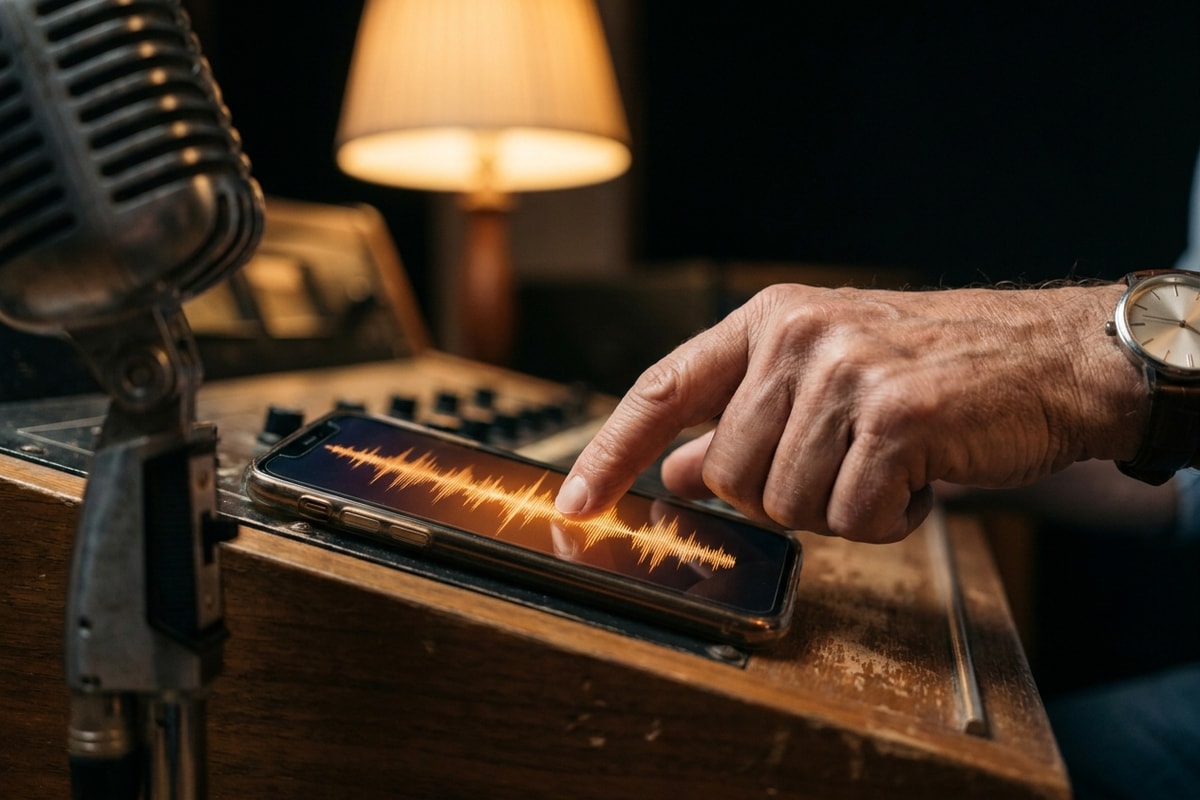
The first time it happened to Margaret, she was standing in her own kitchen holding her phone at arm's length, listening to a voicemail she had just left her daughter by mistake. A thin, wobbly, slightly breathless voice was coming out of the speaker. It took her a second to understand that the voice was hers.
She was 62. She did not feel 62. And she had not, until that thirty-second recording, realized that the voice she carried in her head had stopped matching the one everyone else was hearing.
If you have had a moment like that, on a voicemail, a video call, a recording someone sent you afterward, this article is going to make a claim that sounds too simple to be true. So I will say it plainly and then spend the rest of the page earning it: the change you are hearing usually is not "just getting old." It has a specific, physical cause. And in most people that cause responds to training.
I did not believe that either when I started reporting this. Here is what changed my mind.
"It's just age" is the answer nobody checks
Ask most people why an older voice sounds thinner, or why it tires halfway through a sentence, or why it cracks reaching for a note it used to hit, and they will shrug and say the obvious thing. Age. The same answer we give for gray hair and stiff knees.
The trouble is that "age" is not a mechanism. It is a place where curiosity stops. And when I asked people over 50 to describe what they actually noticed, none of them described "aging." They described very specific, very physical things:
"My voice sounds weaker. It runs out of air. It sounds old to me now. I've lost my range. It got raspy, rougher, harder to control."
Those are not vague complaints about time passing. They are descriptions of a system that has lost strength. Which raised the obvious question nobody had asked me: strength of what?
Why the usual fixes miss
Before I get to the cause, it is worth saying why the things people try first tend to do nothing.
Hydration helps a dry throat, but a dry throat is not what is happening here. Throat lozenges, tea with honey, clearing your throat more, talking less to "rest" the voice: some of these are actively counterproductive, and none of them touch the underlying issue, because the underlying issue is not in your throat lining.
The medical route often dead-ends too. Plenty of people over 50, especially women moving through menopause, get told by more than one doctor that nothing is wrong. And strictly speaking, the doctor is right. There is no disease. There is nothing to treat. Which is exactly why the answer they are given feels so unsatisfying: it explains nothing and offers nothing.
So if it is not dryness, and it is not illness, what is left?
The part nobody mentions: your voice is a muscle
Here is the piece that reframes everything.
The sound of your voice is produced by two small bands of muscle in your larynx, your vocal folds. They are tissue you train and de-train exactly like any other muscle in your body. And like any other muscle, when they are not challenged, they thin, they lose tone, and they stop closing as cleanly as they used to.
Doctors have a name for the age-related version of this: presbyphonia. It means the vocal muscles have become deconditioned. They bow slightly instead of meeting firmly, so more air leaks through when you speak. That air leak is the breathiness. The thinness. The running-out-of-air-mid-sentence. The wobble.
Read that again, because it is the whole point: what you are hearing is not decay you have to accept. It is a deconditioned muscle. And a deconditioned muscle can be reconditioned.
This is not a fringe idea. Speech-language pathologists treat presbyphonia with structured vocal exercises, the voice equivalent of physical therapy, and it is a recognized, studied approach. The principle is the same one every gym membership is sold on: a muscle you train gets stronger, and it does not much care how many birthdays you have had.
That is the reason a room full of professional singers and speakers in their 60s, 70s, and 80s still sound the way they do. It is not luck and it is not surgery. Their voices are the most trained muscles they own.
What this does NOT mean
I want to be careful here, because the honest version of this story is more believable than the hyped one.
This is not a promise that anyone gets the voice of their thirties back. It is not a medical treatment and it does not cure anything. What the research and the practitioners support is more modest and, frankly, more useful: a noticeable improvement in strength, steadiness, and control, from targeted, consistent practice of the right exercises for where your voice has actually deconditioned.
And that last part, where your voice has actually deconditioned, turns out to be the thing most people get wrong. Because "do some vocal exercises" is about as useful as "go to the gym" with no idea which muscles are weak.
Find out where your voice has actually deconditioned.
Take the 60-Second Voice Quiz$47 one time. A full year to change your mind. [VERIFY offer vs live VoiceQuiz funnel before publish]
How you find out where to start
This is where I ended up spending the most time, and where the reporting turned practical.
The team behind the vocal coach Roger Love, who has spent decades keeping professional voices strong well past the age most voices fade, built a short assessment for exactly this problem. It is called the Voice Quiz. It takes about a minute. It asks about the specific things you have noticed, the breathiness, the range you have lost, the fatigue, the pitch, and it uses your answers to identify where your voice has deconditioned and which retraining track fits you.
When you talk for a while, what happens first?
I was skeptical of a quiz. I expected a thin lead-magnet with a sales pitch bolted on. What it actually does is narrow "train your voice" down to the two or three things that would matter most for your pattern, which is the difference between practice that works and practice that wastes your mornings.
It costs $47, one time. Not a subscription. And it comes with a 365-day money-back guarantee, which is a longer window than almost anything else you will buy this year, and a fairly strong signal that they expect it to hold up.
The quiz takes about a minute. It tells you where to start.
Take the 60-Second Voice Quiz$47 one time. A full year to change your mind. [VERIFY offer vs live VoiceQuiz funnel before publish]
What "noticeable" looks like
I asked what a realistic first month looks like, in a few minutes of practice a morning. The honest answer, and the one the copy sticks to, is not a transformation reel. It is smaller and more real: less air running out before the end of a sentence, a voice that holds up through a long phone call instead of fraying, a little more of the range that had quietly gone missing.
One real, attributed customer story from the 50+ cohort (first name + last initial, with permission) goes here. No age-matched before/after testimonials exist yet, so no dramatic transformation claim may run. Cap at "noticeable improvement" until a real story is captured. Do not fabricate.
If your voice changed suddenly rather than gradually, over days rather than years, that is a different situation and worth a doctor's visit. Gradual is the pattern this addresses. Sudden is not.
Where to start
If the voicemail moment landed for you, the useful next step is not to buy anything or believe anything. It is to find out what is actually going on with your voice.
You are not committing to a program. You are getting the one piece of information every useful plan starts from: where you actually are. From there, if the retraining track fits, it is $47 one time to start, and a full year to change your mind.
The voice on that voicemail does not have to be the final version. For most people over 50, it is not decline they are hearing. It is disuse. And disuse is the most fixable thing there is.
See where your voice has deconditioned, and which retraining track fits.
Take the Voice Quiz Now$47 one time. A full year to change your mind. [VERIFY offer vs live VoiceQuiz funnel before publish]